
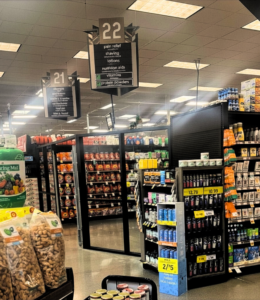
I walked into a grocery store for laundry detergent and hair dye. What I walked into instead was a glass enclosure — floor-to-ceiling panels, sliding doors, a separate checkout station — and the quiet awareness that I was being watched. Not greeted. Not helped. Just watched.
Inside that enclosure: Tide Pods, detergent, Pull-Ups, PediaSure, protein powder, collagen water, vitamins, shampoo, conditioner, lotion, makeup, sunscreen, baby powder, Band-Aids, hydrogen peroxide, pain relief, insoles, and more.
Not a pharmacy. Not a jewelry counter. A grocery store aisle.
To buy detergent, I had to check out inside the enclosure — then get back in line for the rest of my cart.
Two lines. One trip. Zero desire to return.
And the hair dye I needed? I didn’t skip it. I bought it somewhere else.
Inside these glass enclosures, something happens that no loss prevention metric captures:
You stop feeling like a customer. You feel like a suspect.
You are being asked to opt into a surveillance experience just to buy shampoo and Band-Aids — and the psychological effect is real. Psychologists call it reactance: when people feel their autonomy is restricted, they disengage.
They leave. They don’t come back.
And today, every friction point has a frictionless alternative — usually one tap away.
For me, that alternative was Amazon.
Look at these photos for a second. Really look.
One entrance. One exit. A confined space designed to control access.
My throat tightened. That instinctive reaction: I just want to get out of here.
Then the second realization hit — the one that’s harder to ignore. Not paranoia. Awareness.
The kind that happens when an environment is designed to make you feel observed — whether intentionally or not.
You know you’re not doing anything wrong. But suddenly, it feels like you have to prove it.
While Tide sat locked behind glass, other detergent brands sat openly on a shelf nearby.
No enclosure. No wait.
Tide didn’t choose that placement. But here’s the real question:
Does Procter & Gamble know that, in this store, their product is effectively behind a barrier — not just physically, but experientially?
And if they do know, has anyone measured what it’s costing them?
The shopper standing in that glass box isn’t waiting out of brand loyalty. They’re grabbing what’s accessible — or buying it online later.
Either way, the locked brand loses the sale, the basket, and potentially the habit.
This is the Locked-Shelf Effect: when restricted access suppresses demand, shifts behavior, and distorts what sales data appears to show.
And it’s not just detergent.
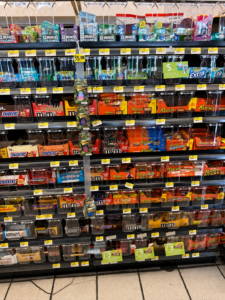
Candy bars — one of the most impulse-driven purchases in retail — are now being locked up in some stores. A $2 product that depends entirely on ease of access.
Add friction, and the purchase disappears.
The National Retail Federation estimates retail shrink at nearly $100 billion annually.
That’s real. It’s measurable. It shows up in reports.
But what about the cost of locking merchandise?
That number doesn’t exist.
Retailers justify lockups with one metric: shrink reduction. Theft goes down. The math looks clean.
But nobody is measuring what else goes down — this is where the Locked-Shelf Effect becomes invisible:
None of this shows up in a shrink report.
This is the question CPG brand managers should be asking:
You’ve invested in placement, displays, and promotions to drive conversion at the shelf. But somewhere along the line, your product was placed behind a locked barrier — and you likely weren’t told.
Your product is visible. It’s just not accessible.
That’s not a shelf. That’s a display case.
And display cases don’t drive sell-through.
These aren’t luxury goods. They’re everyday essentials — detergent, diapers, vitamins, sunscreen. Products that consumers typically buy without hesitation.
Until there’s a barrier.
Then the decision becomes: “I’ll just order it online.”
This is fundamentally a visibility gap.
Brands lack visibility into what the shopper actually experiences in-store, while retailers measure the benefit of locking products — but not the cost.
That’s the gap Survey closes — turning in-store reality into actionable data before it becomes lost revenue.
With real-time store intelligence and targeted execution, brands can:
See how brands are identifying and fixing in-store execution gaps in our Case Studies.
This shifts the conversation with retail partners:
Not just where your product is — but how the experience around it is impacting performance.
Retailers built glass enclosures to stop theft.
But is the fix better than the problem?
Locked shelves don’t just slow shoplifters.
They stop customers. They distort demand signals. They reduce basket size. They erode brand relationships.
The Locked-Shelf Effect is already happening in stores.
The only question is whether you can see it.
With Survey, brands can distinguish between true demand decline and access-suppressed sales — gaining the visibility to identify issues, prioritize action, and recover lost revenue.
Because there’s a fundamental difference between:
A product that shoppers don’t want
…and a product they couldn’t access
Right now, most brands can’t tell the difference.